Millet in Tom Brown: Nutrition Facts, Processing and Why It Is Used in Baby Cereal
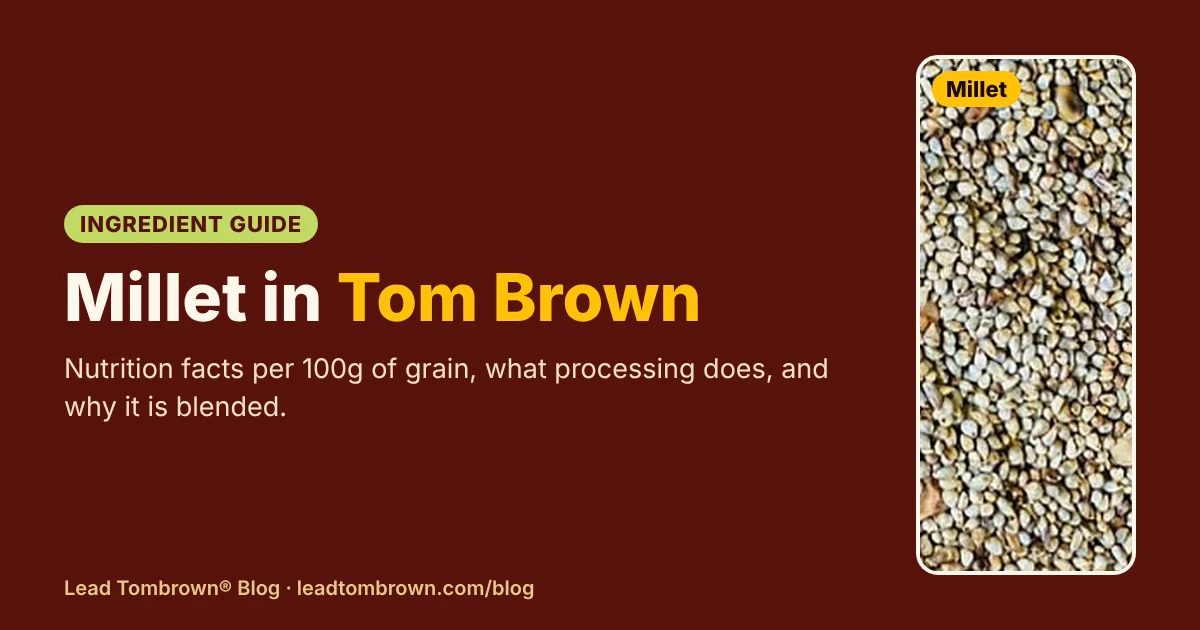
Millet is one of the oldest grains grown in Nigeria and across the Sahel. You will find it in pap, kunu, fura and, in many recipes, tom brown. This article looks at what millet contains, what processing does to it, and why it is usually blended with other ingredients in baby cereal. It is general information, not medical advice.
What is millet?
Millet is a group of small-seeded cereal grains. The two most common in Nigeria are pearl millet (gero in Hausa) and finger millet. Both are drought-tolerant and have been staple foods for generations.
Millet nutrition facts (per 100g of grain)
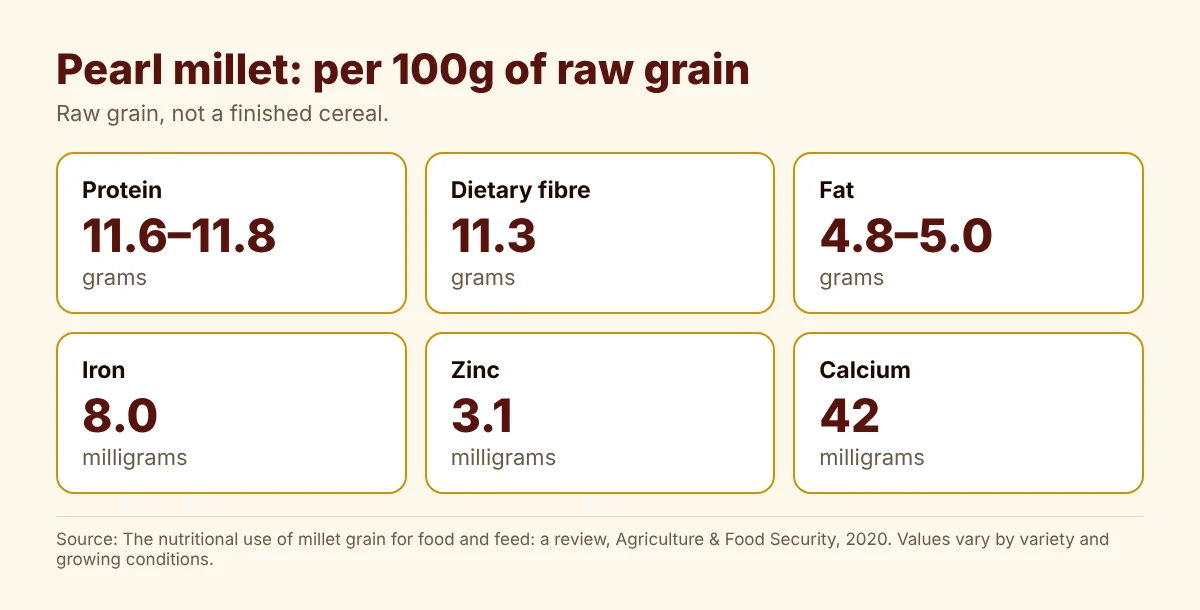
A 2020 review in Agriculture & Food Security on the nutritional use of millet reports these values for the raw grain:
| Nutrient (per 100g) | Pearl millet | Finger millet |
|---|---|---|
| Protein | 11.6 to 11.8 g | 7.7 g |
| Fat | 4.8 to 5.0 g | 1.8 g |
| Dietary fibre | 11.3 g | 15 to 22 g |
| Iron | 8.0 mg | 3.3 to 14.9 mg |
| Calcium | 42 mg | 398 mg |
| Zinc | 3.1 mg | 2.3 mg |
These figures are for plain, raw millet grain. They are not the nutrient content of any finished cereal, which depends on the whole recipe and how it is cooked. Values also vary with variety and growing conditions.
The same review states that pearl millet is free of gluten and has a low glycaemic index. Those statements describe the millet grain itself, not any particular product.
What about phytates and tannins?
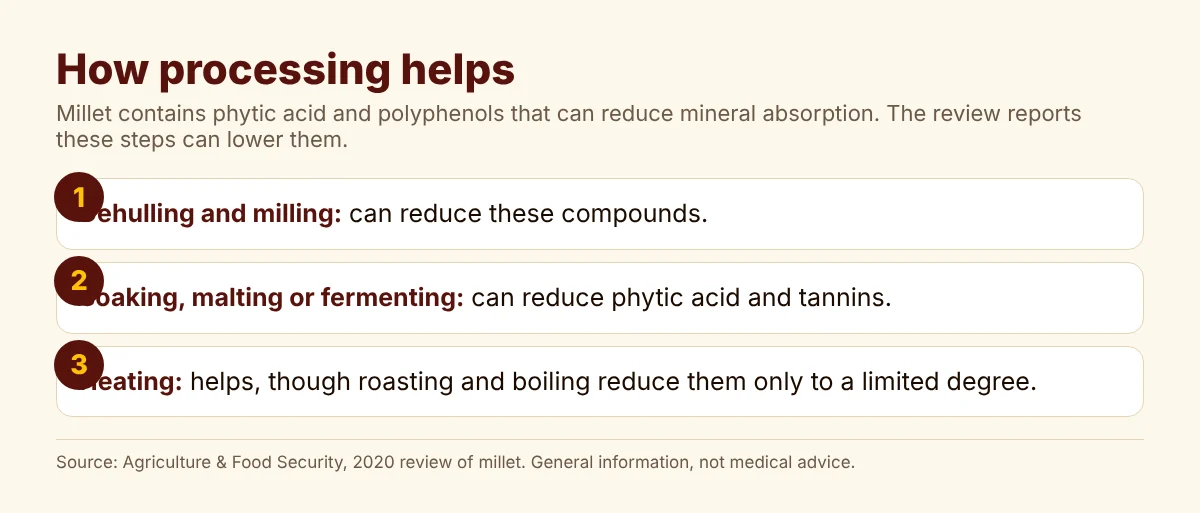
Like many whole grains and legumes, millet contains compounds such as phytic acid and polyphenols (including tannins in some varieties). These can reduce how well the body absorbs minerals such as iron and zinc. The review reports that dehulling, milling, malting, soaking, heating and fermentation can reduce these compounds, though roasting and boiling reduce them only to a limited degree. This is one reason why careful processing of grains for baby cereals matters, and why variety in a baby's diet matters.
Why is millet blended with other ingredients?
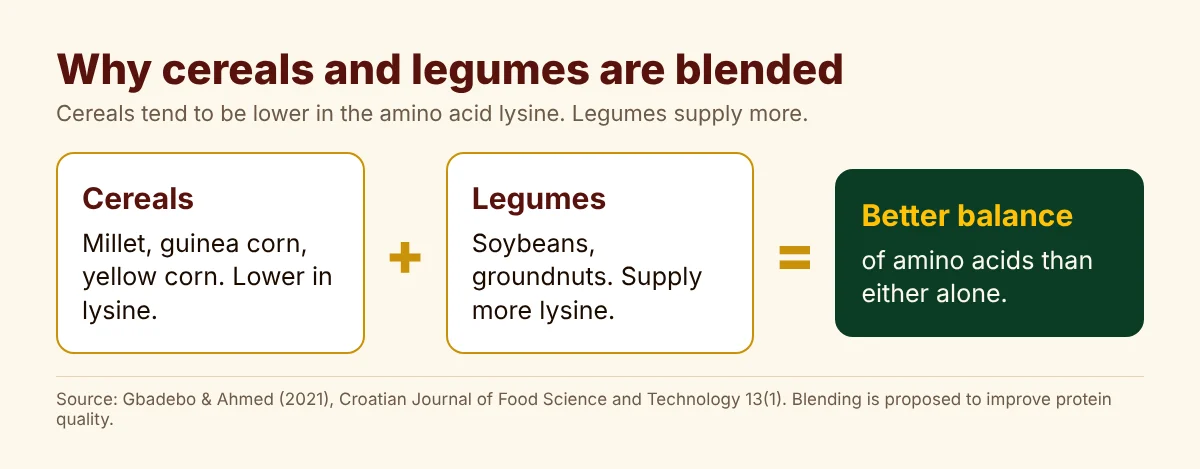
Cereals, including millet, are usually lower in the amino acid lysine. Legumes such as soybeans and groundnuts supply more of it. A 2021 study on guinea corn meal enriched with soybean and groundnut for infant feeding notes the same thing: cereals are deficient in lysine, and blending them with soybean and groundnut is proposed to improve protein quality and nutrient content. This is a main reason tom brown recipes combine grains with legumes.
Safety and feeding notes
- The WHO recommends starting complementary foods at about 6 months, in small amounts, increasing gradually, while continuing breastfeeding.
- Prepare porridge fully cooked, smooth and warm, using clean utensils.
- Ask your child health worker if your baby has a history of food allergy.
Millet in Lead Tombrown®
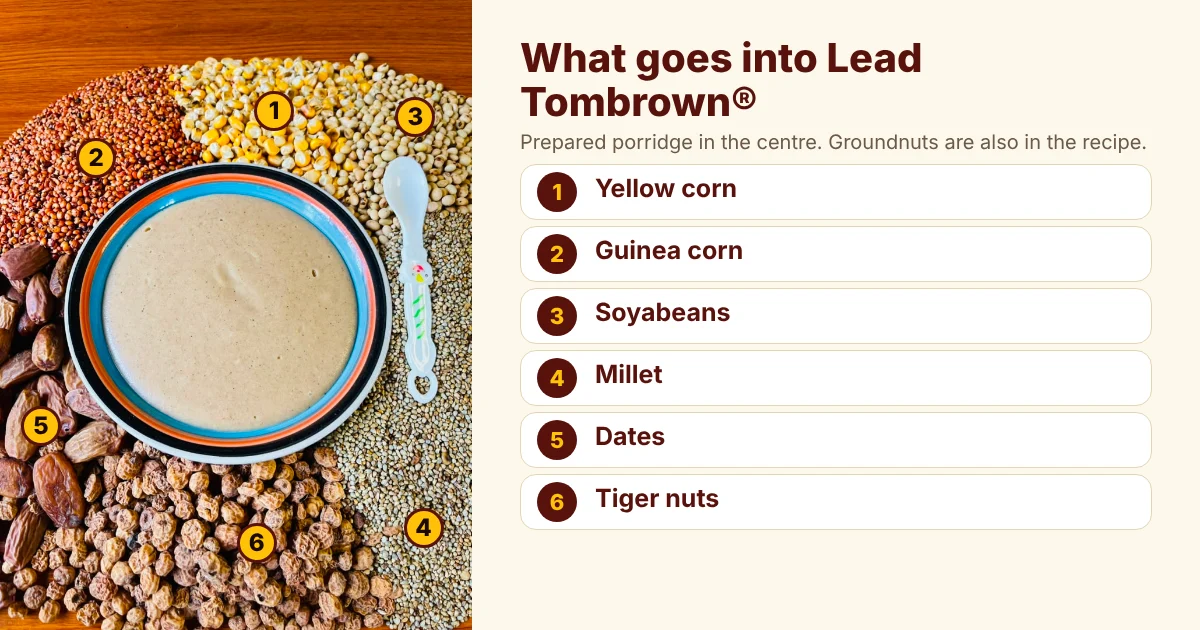
Lead Tombrown® is made from yellow corn, guinea corn, soyabeans, millet, groundnuts, dates and tiger nuts, with no added sugar. Allergy caution: it contains soybeans, tiger nuts and groundnuts. It is NAFDAC registered (A8-115652L) and meant for babies from 6 months. To find a distributor near you, visit the Lead Tombrown buy page.
Frequently asked questions
Is millet the same as guinea corn?
No. Millet and guinea corn (sorghum) are different cereal crops. Millet grains are smaller. Both are used in Nigerian cereals and are often blended.
How much protein is in millet?
The review reports about 11.6 to 11.8 grams of protein per 100 grams of pearl millet grain.
Is millet gluten free?
The review states that pearl millet grain is gluten free. A finished cereal may contain other ingredients, so always read the pack.
Can babies eat millet?
Babies can start soft, fully cooked complementary foods from about 6 months, according to the WHO. Millet is commonly used in porridge, and any porridge should be smooth and cooked properly.
What is the difference between millet and maize?
They are different cereals. Maize (corn) is larger, and yellow maize is the type often used in cereals. Millet is a small-seeded grain.
Sources
- The nutritional use of millet grain for food and feed: a review, Agriculture & Food Security 2020
- Gbadebo and Ahmed (2021): Proximate composition and sensory evaluation of Guinea corn meal enriched with soybean and groundnut for infant feeding, Croatian Journal of Food Science and Technology 13(1)
- WHO: Complementary feeding
Please note: This article is general information, not medical advice. Every baby is different. For questions about your baby's health, feeding or allergies, speak to your doctor or child health worker. The WHO recommends exclusive breastfeeding for the first 6 months and continued breastfeeding up to 2 years or beyond alongside suitable foods.
Looking for Lead Tombrown® near you?
Choose your size, tell us your location, and we connect you with the nearest distributor. NAFDAC registered (A8-115652L).